

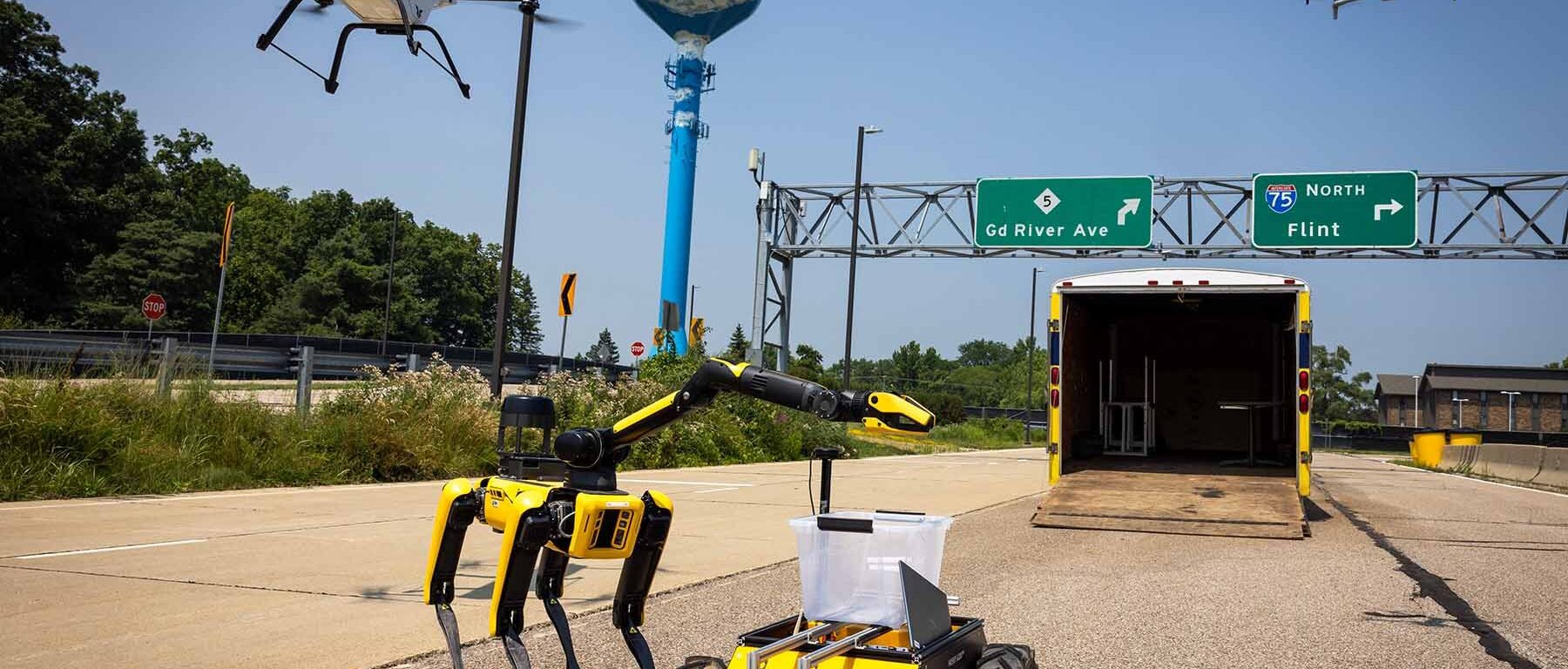
Umich – A flight corridor for testing drones and electric aircraft will link the University of Michigan’s one-of-a-kind autonomy research and proving ground facilities in Ann Arbor to Michigan Central’s real-world, urban testbed and innovation district in Detroit.
Announced July 17 by Gov. Gretchen Whitmer, the roughly 40-mile research skyway will be the centerpiece of M-Air, a new public-private partnership U-M is launching for advanced air mobility. M-Air is to be part of the existing public-private partnership Mcity, which provides a connected and automated vehicle test facility under the U-M Transportation Research Institute.
The state of Michigan is providing $1 million in anchor support for M-Air as part of a broader advanced air mobility initiative.
“The next frontier of mobility is moving from land to sky, where drones and electric aerial vehicles can transform how we move people and goods. Michigan Engineering’s M-Air partnership will play an important role in propelling the state to national leadership in advanced aviation technology and developing the workforce we need to sustain it,” said Karen Thole, the Robert J. Vlasic Dean of Engineering and a professor of mechanical engineering and aerospace engineering.
The M-Air public-private partnership
M-Air will enable advanced air mobility researchers and companies to test their technologies in realistic environments, with a particular focus on beyond-line-of-sight operation of autonomous aircraft as well as battery powered aircraft that use vertical take off and landing (VTOLs), like helicopters. Current regulations restrict most drones to within the range a pilot can see unaided, which limits their usefulness. Both drones and electric VTOLs have been identified as national priorities in a recent White House executive order.


