

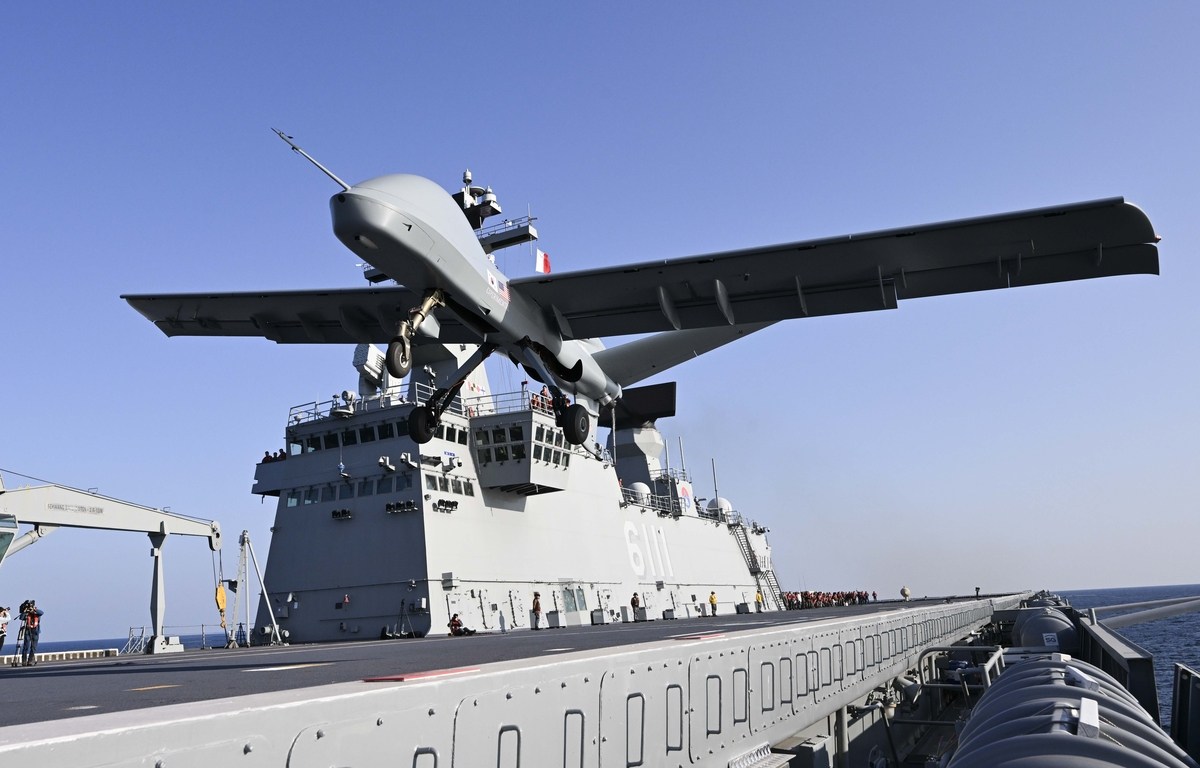
The Republic of Korea (ROK) Navy’s transition toward a MUM-T fleet is becoming increasingly defined, with shipbuilders and aerospace firms unveiling platforms and systems to support future unmanned naval operations via a drone carrier project.
A seminar on the construction of a manned-unmanned teaming (MUM-T) aircraft carrier for the Republic of Korea Navy and the development of unmanned maritime capabilities was recently held at the National Assembly, hosted by People’s Power Party representative Yong-won Yoo.
The main topic of the seminar was the Republic of Korea (ROK) Navy’s future MUM-T fleet, based on a report submitted by the Navy. According to the plan, the Navy intends to establish a MUM-T Battle Group centered around a new concept of a drone aircraft carrier capable of operating both manned and unmanned aerial vehicles (UAVs) and supporting amphibious assault operations.
The plan includes upgrading the two existing amphibious assault ships, ROKS Dokdo and ROKS Marado, to enable UAV takeoff and landing as well as MUM-T command capabilities. Additionally, the Navy aims to design and construct a new 30,000-ton-class (light load) drone carrier over the next 11 years, with the goal of bringing it into operational service in the late 2030s.
As part of the Navy Sea GHOST initiative, which addresses manpower shortages due to population decline, the ROK Navy has shown increasing interest in unmanned systems. Notably, last year, General Atomics’ Mojave STOL UAV successfully conducted a take-off demonstration from ROKS Dokdo, drawing attention to the possibility of repurposing existing amphibious assault ships into drone carriers.
Currently, ROKS Dokdo is undergoing a performance improvement program (PIP) at HJ Shipbuilding & Construction, which began this month. Following the Mojave UAV demonstration, inquiries were made to relevant agencies regarding whether the ongoing PIP included plans to expand the flight deck or upgrade systems to support stable UAV landings. At the time, the response was that such upgrades were not part of the current PIP. However, with plans for UAV operations on the two existing amphibious assault ships now taking shape, additional performance upgrades and modifications are expected to follow.
ROK Navy Photo | Yonhap news


